Desktop Chromium browsers · version 1.6.1 · English + Russian

Study, copy, and media tools for JW.org

Highlight a thought, keep a note beside the text, copy one verse or a verse range, download a short audio or video segment, and fix common player annoyances. Your study data stays in your browser.

  • Approved and available in Chrome Web Store
  • Chrome, Edge, and other Chromium browsers on a computer
  • Mozilla-signed Firefox Android beta available
  • iPhone/iPad TestFlight is still being prepared
  • No account or telemetry
  • Russian UI follows the browser language
StudyNavTools for this page
Ready on this Bible chapterVerse 3 is selected
Feature settings

Android, iPhone, and iPad

Install the Android beta

The mobile version keeps nine touch-friendly study and sharing tools. It leaves out the heavier media and page-layout tools that are difficult to make reliable on a phone.

Mozilla-signed beta

Android: Firefox 142 or newer

Firefox downloads a self-distributed extension first, then installs it from a file. Use Firefox—not Chrome, Edge, or Brave—and follow these steps:

  1. Open this page in Firefox for Android and download the signed beta below.
  2. Open Settings → About Firefox and tap the Firefox logo five times quickly.
  3. Go back to Settings and open Install Extension from File.
  4. Choose StudyNav-Mobile-1.6.1-Firefox-Android.xpi, review the requested access, and tap Add.
Download signed Android betaBeta 1 · 89.8 KiB · Mozilla-signed · manual updates
Waiting for TestFlight

iPhone and iPad: Safari

Install the StudyNav app from TestFlight, enable its Safari extension, and allow it only on JW.org and WOL. The TestFlight link will appear here after Apple accepts the beta build.

What is included

Six highlight colors, notes and tags, saved places, citations, QR codes, clean copy, exact paragraph or verse links, image descriptions, and the available-language count.

What stays on the computer

Verse audio, audio/video clipping, player and transcript controls, image downloads, search, and page-layout changes remain in the desktop extension. Mobile study data stays in that browser on the device.

Why the five taps? Firefox for Android currently puts Install Extension from File behind a hidden menu for self-distributed add-ons. This beta does not update automatically; install a newer signed XPI when one is released. See Mozilla’s instructions, the release details, and current proof in Issue #10. SHA-256: 9d54e32552ea048773b09bcbac926d155f60ec4f7d3db4625b15f8731fbb8c5c.

StudyNav 1.6.1

What changed—and where to click

If you used an earlier version, start with these controls. All 23 settings and their current defaults are listed below.

Updating an existing copy? Follow these steps
Notes

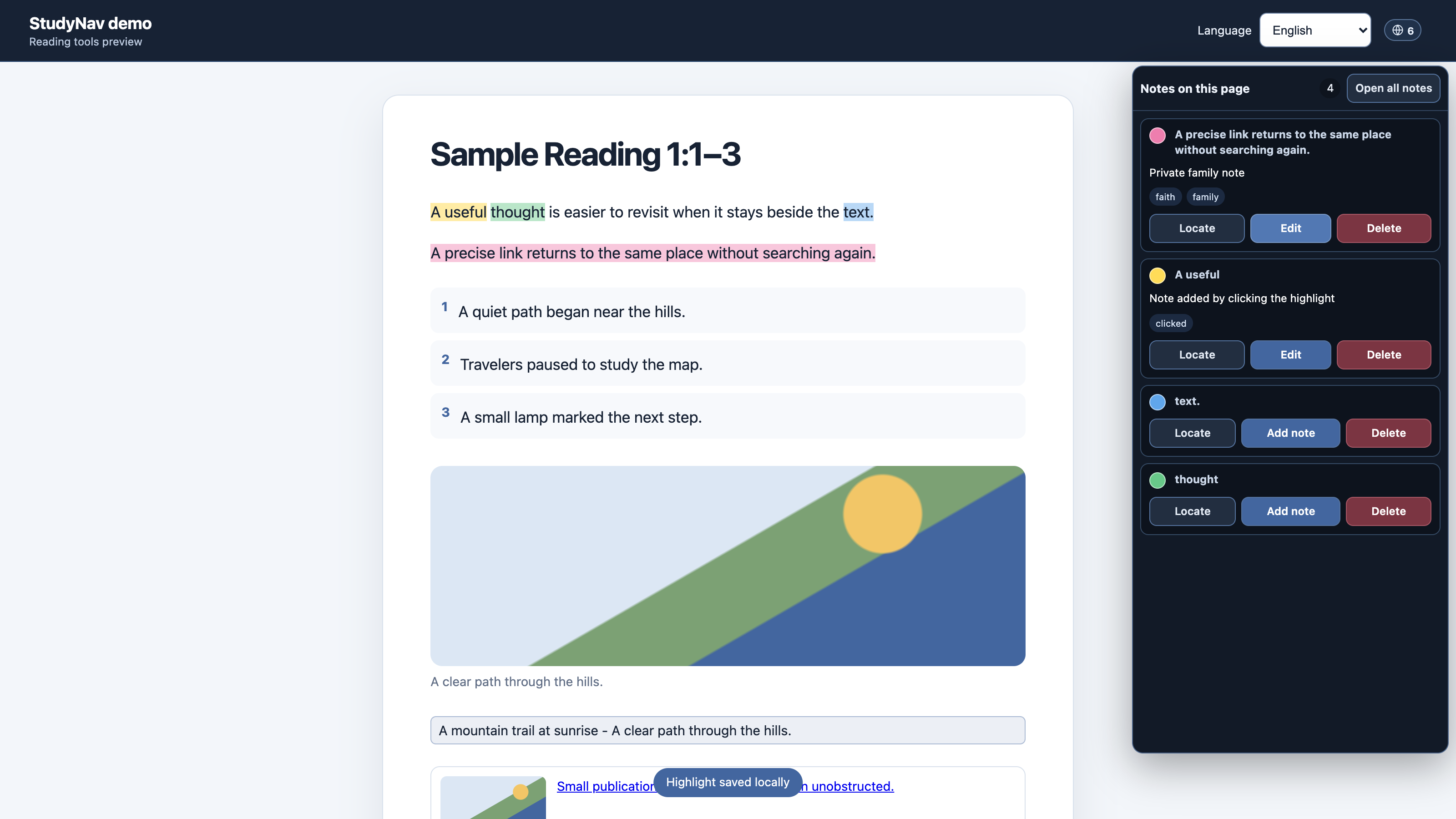
Write and change a note beside the text

  1. Highlight the thought.Select the text and choose one of the six colors.
  2. Click the colored highlight.Its note editor opens in the right rail; there is no separate pop-up window.
  3. Write the note and its tags.Comma or Enter turns each finished tag into a separate chip.
  4. Use Edit or Delete later.Both buttons stay visible on the saved note.
StudyNav notes rail with colored highlights, tag chips, and visible Edit and Delete buttonsOpen the notes example at full size
Audio and video

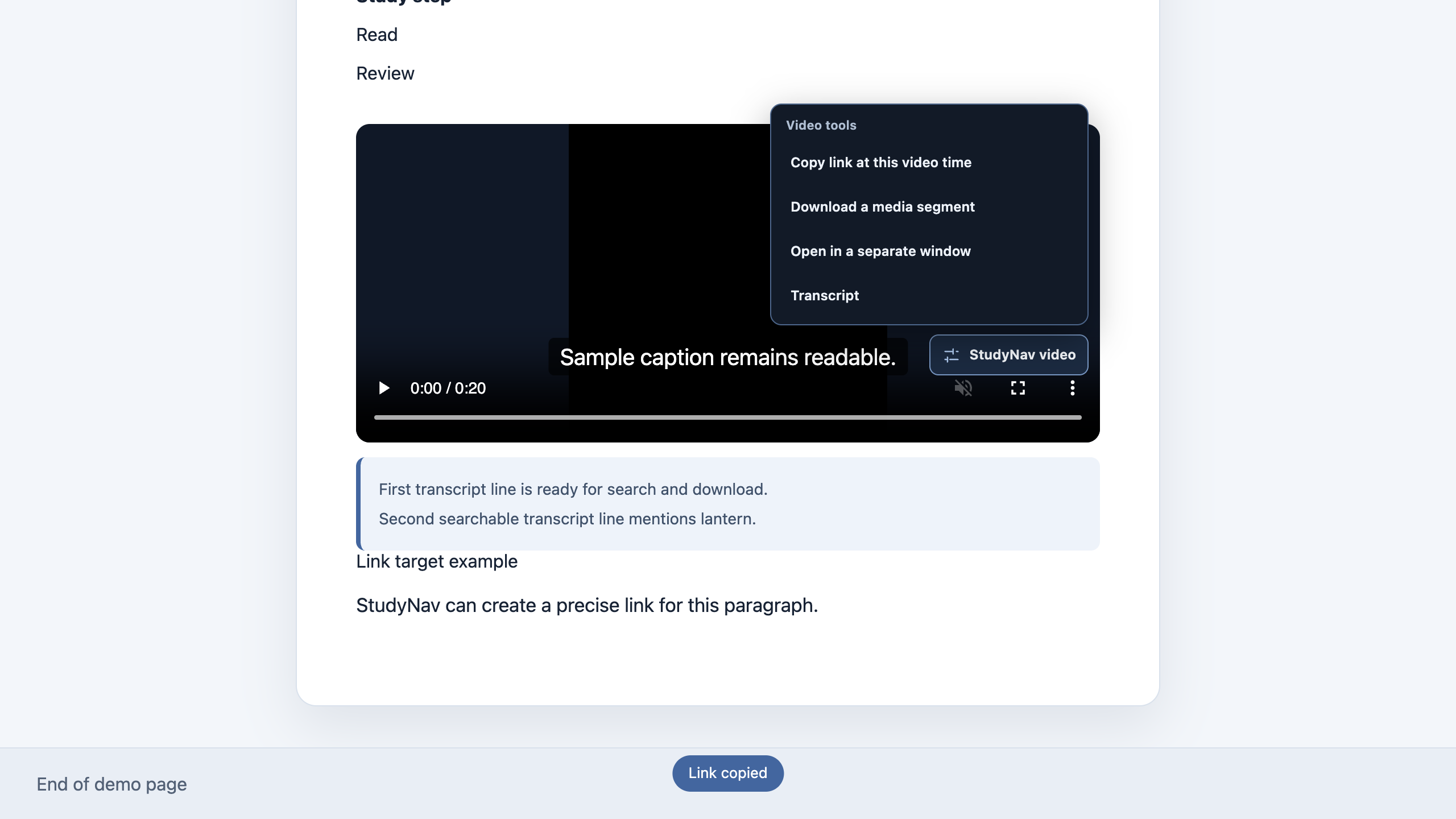
Open one compact menu on the player

  1. Press StudyNav audio or StudyNav video.The menu is attached to the media instead of floating over the whole page.
  2. Download only the needed part.Enter the start and end time: up to five minutes for audio or three minutes for video.
  3. Move playback to another window.The original pauses and the new window continues at the same time.
  4. Open Transcript on a video.The button remains visible and tells you plainly when captions are unavailable.
Compact StudyNav video menu with current-time link, media segment, separate window, and Transcript actionsOpen the media menu example at full size

On WOL and article pages

  • Audio actions appear above the article and do not cover its title.
  • Time-related actions appear only when the page actually has audio or video.
  • Wider text and separated table rows now work on JW.org and WOL articles when enabled.
  • Image buttons and descriptions skip small publication covers and previews.

Update without losing local study data

  1. If StudyNav came from Chrome Web Store, the browser updates it automatically.
  2. If you previously loaded a ZIP, first export a JSON backup from Study library.
  3. Install the Chrome Web Store version, open its Study library, and import that JSON.
  4. Check that your notes and saved places appear, then disable the old unpacked copy.

What you can do

Use StudyNav for these six tasks

The controls appear on the JW.org pages where they work.

01

Keep a place for later

Save the exact paragraph or verse you want to revisit for a meeting, talk, or personal study—not just the top of the page.

Use it when:you found something useful but cannot study it now.
02

Send a quote with its source

Copy the selected words, their reference, and a precise link in one action. It is ready to paste into a message or notes.

Use it when:you want the reader to see both the quote and its source.
03

Use several verses together

Select the first verse, choose Select several, then select the last. Copy the text, copy one link, or download the range as one audio file.

Use it when:one thought continues through verses 3–5.
04

Get a shorter publication link

StudyNav opens the same publication through a JW.org address without the extra technical parts.

Use it when:you want a simple address to save or send.
05

Download only what you need

Save the narration of one verse or several consecutive verses. For other media, enter start and end times to save a short WAV or WebM clip.

Use it when:you need a short excerpt without trimming the full file yourself.
06

Keep notes beside the text

Six Library-like colors, notes, and tags are stored locally. On wide screens, notes appear in a right rail; on narrow screens, a Notes button opens them.

Use it when:you want the note visible without moving or covering the article.

Page appearance

What changes on the screen

Article appearance changes start off. Turn on the ones you want in StudyNav settings.

Article navigation

Keep article navigation at the top

The article title and buttons stay reachable during a long scroll on JW.org. WOL already keeps its own header visible, so this setting leaves it alone.

Before
Wider

Wider reading column

Article text receives more space on wide JW.org and WOL pages. Dialogs, navigation, and the notes rail keep their own size.

BeforeSeparated
Row oneRow one
Row twoRow two

Separate table rows

Spacing, borders, and alternating backgrounds make it easier to follow each row.

Picture stays visible
▶︎ 00:18

Remove video shading

JW Player’s dark edge gradient is removed when controls appear. Buttons remain visible, but the picture no longer darkens around them.

Video guide

See the complete feature overview

Open the chapter list below the video to jump directly to one of the 23 settings. The current note and media buttons are shown in the version 1.6 guide above.

English · 23 chapters · 4:17
Jump to a feature

All features

What each setting does

For new users, image downloads and the three article-layout changes start off. If you installed StudyNav before, press Reset recommended defaults to use the same set.

Study and sharing 5 settings

FeatureWhat happensDefault
Highlights, notes, and tagsHighlight a thought, then click that highlight to write or change its note in the right rail. Comma or Enter saves each tag as a chip; Edit and Delete are visible beside the note.On
Return to a saved placePress Save place beside a paragraph or verse. Later, open that entry in the StudyNav library to return directly to it.On
Quote with its sourceCopy the selected text, publication title, and link to that exact place in one action. The result is ready to paste into a message or notes.On
QR code for another deviceShow a QR code for the current page or selected place, then scan it with your phone.On
Short link to the same publicationOpen the same publication through a JW.org address without extra technical parts. The shorter address is easier to save or send.On

Bible and articles 7 settings

FeatureWhat happensDefault
Audio for one or several versesSelect one verse or several consecutive verses and press Download audio. StudyNav saves the selected narration as one WAV file on English, Russian, and Ukrainian Bible pages.On
Copy only the verse wordsThe copied result keeps the verse words. The verse number, reference letters, footnote links, and StudyNav buttons are left out.On
Link to the exact placeCopy a link that opens the chosen paragraph, one verse, or several consecutive verses instead of only the top of the page.On
Find a publication by its codeIf you already know a publication code or document number, open the regular JW.org and WOL search for it. This is not semantic or AI search.On
Show an image descriptionOpen the caption and text description that the page authors provided for a full article image. Compact publication previews are left unchanged.On
Download an article imageA regular Download image button appears below suitable full images in an article, not over small publication previews.Off
See how many languages are availableThe language control shows the exact number of translations available for the current page.On

Article appearance 3 settings

FeatureWhat happensDefault
Article navigation while scrollingOn JW.org, the article title and navigation buttons stay at the top during a long scroll. WOL already pins its own header, so this setting does not move it.Off
Wider text columnOn wide JW.org and WOL article pages, more text fits on each line. Navigation, dialogs, and the notes rail do not stretch.Off
Separate table rowsJW.org and WOL article tables gain spacing, borders, and alternating row backgrounds so your eye is less likely to jump between cells.Off

Video and audio 8 settings

FeatureWhat happensDefault
Keep video bright on hoverWhen you move the pointer over a video and the player buttons appear, the picture no longer darkens around the edges. The player buttons still hide after you stop moving the pointer.On
Make subtitles largerPlayer captions become larger and higher-contrast so they are easier to read.On
Control the player from the keyboardSpace or K pauses and resumes; J and L seek; M mutes; F enters full screen. When the cursor is in a text field, the keys type normally.On
Copy a link at the current timeOpen the compact StudyNav menu on an audio or video player and copy the page address with a line such as Time: 2:14. This action appears only beside media.On
Download a segment by timeEnter a start and end time in the player menu. Save up to five minutes of audio as one WAV file or three minutes of video as one WebM file.On
Return to where you stoppedStudyNav remembers where you stopped a video. Next time, open StudyNav on the player and press Resume to return to that point.On
Open the player in a separate windowThe original player pauses and the new window continues at the same point. If the browser blocks autoplay, press Play once in the new window.On
Open TranscriptThe video menu always keeps Transcript visible. It searches and downloads captions when the page provides them, or clearly says that no transcript is available.On

Computer installation

Install StudyNav from Chrome Web Store

No ZIP, commands, or Developer mode are needed. Use a computer with Chrome or a compatible Chromium browser; this desktop listing does not install the separate mobile beta.

  1. Open the StudyNav store pageUse the button on this page to open the verified Chrome Web Store listing.
  2. Press Add to ChromeConfirm Add extension when the browser asks.
  3. Pin StudyNavOpen the puzzle-piece menu and press the pin beside StudyNav. Then open any JW.org or WOL article.
Chrome Web StoreVersion 1.6.1
StudyNavUnofficial Study Tools
Available
Add StudyNav to Chrome

Used the older ZIP version? Export your Study library JSON before switching. Install the Store version, import the JSON there, check your notes, and only then disable the unpacked copy. Contributors can build the current source from the GitHub repository; most people should use the Store.

Data

What stays local—and what opens externally

Stored in the browser

  • Highlights, selected quotes, notes, and tags
  • Saved page, paragraph, verse, and range links
  • Where you stopped in recently watched media
  • A backup file you can export and import

Requested only after an action

  • Official JW audio or video needed for the clip you chose
  • An article image after Download image
  • Google image search after you submit a query
  • No account, analytics, or remote note sync

Questions

Answers before you install

Compatibility, audio, notes, links, and common limitations.

Which browsers are supported?

The desktop release supports current Google Chrome, Microsoft Edge, and compatible Chromium browsers on a computer. The signed mobile beta supports Firefox 142 or newer on Android. Chrome, Edge, and Brave on Android cannot use this package. The iPhone/iPad Safari build is still waiting for TestFlight. Desktop Firefox and Safari packages are not offered.

Is StudyNav an official JW.org extension?

No. It is an independent open-source project and is not produced, endorsed, or maintained by Jehovah’s Witnesses.

Is the publication search powered by AI?

No. It is for cases where you already know a publication code or document number, and opens the regular JW.org/WOL search for it. It does not search by the meaning of the text.

How do I select verses 3 through 5?

Select verse 3, choose Select several, then select verse 5. Copy uses all three verses, Link creates one direct address, and Download audio saves the range as one WAV file. Shift-click still works as a keyboard shortcut.

What does “clean text” remove?

Verse numbers, reference letters, footnote links, and StudyNav labels or buttons. It keeps the actual words of the selected verse or paragraph.

How much text can I highlight?

Up to 10,000 characters in one saved highlight. This is enough for a long excerpt while preventing an accidental whole-page selection from becoming one oversized note.

Why do some options show no change on the homepage?

Image buttons, scrolling navigation, the wider column, and table styling need an article, image, or table to change. On WOL, wider text and clearer tables work in articles; its header is already fixed by the site.

Where is the Transcript button?

Open the StudyNav menu beside a video. Transcript now remains visible there. It searches and downloads captions supplied by the page, or tells you that none are available. StudyNav does not send audio to a transcription service.

Does verse audio work in Russian and Ukrainian?

Yes. On supported English, Russian, and Ukrainian Bible chapter pages, you can download one verse or several consecutive verses. If the chapter media has not loaded yet, start Play Audio once and try again.

Why are clips saved as WAV and WebM?

The browser can create these formats without sending media to a server. The current limits are five minutes for audio and three minutes for video; the guard prevents a tab from using excessive memory, and video is recorded locally in real time.

How do I change or delete a note?

Click its colored highlight or use Edit in the right notes rail. The same rail contains Save, Delete, and Cancel. While typing tags, comma or Enter turns the finished word into a chip.

Why was Download article images still on in my profile?

Older saved settings can outlive new defaults. New installs start with it off. Press Reset recommended defaults in the popup to apply the current defaults to an existing profile.

Can notes synchronize between devices?

There is no remote sync. Export the Study library JSON from one browser profile and import it into another. Import merges valid records and does not delete existing ones.

How do I update StudyNav without losing my notes?

The Chrome Web Store version updates automatically. If you are moving from an older manually loaded ZIP, export a JSON backup from its Study library, install the Store version, and import the JSON into that copy. Check the notes before disabling the old extension; each copy has separate local storage.

Can I use StudyNav on a smartphone?

On Android, yes—as a Mozilla-signed Firefox beta. Download the XPI from the mobile beta section, tap the Firefox logo five times under Settings → About Firefox, then use Install Extension from File. The public download and Android 16 emulator workflows are verified; a physical-phone install through this link is still being checked. iPhone and iPad are not available yet because the Safari build still needs TestFlight.

Does the Android beta update automatically?

No. This first self-distributed beta is intentionally manual. When a newer signed version is released, download its XPI from this guide and install it from file again. Export your Study library JSON before an update and confirm your notes afterward.